Was Artist Mucha Art Deco Christ the Redeemer Art Deco
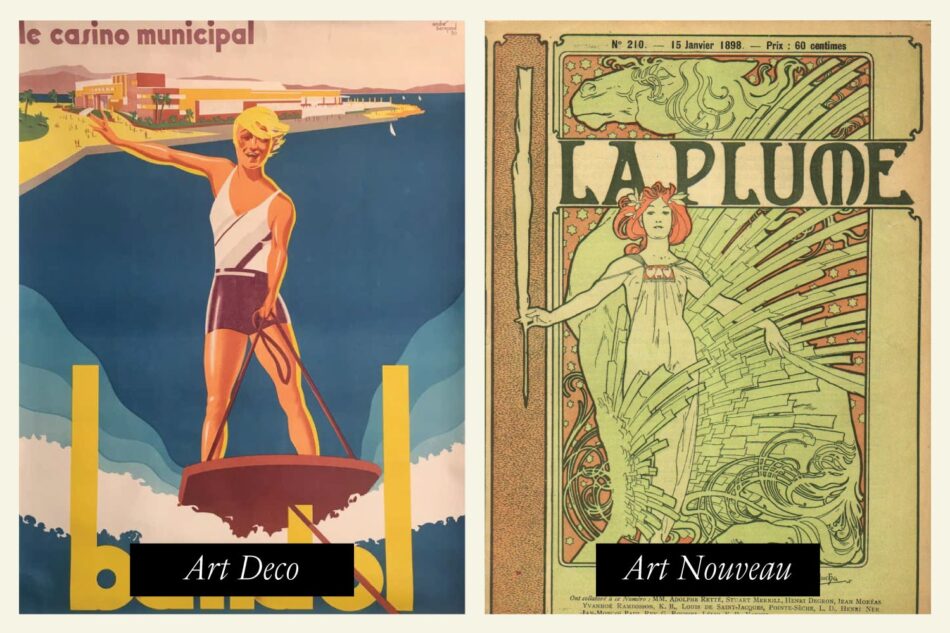
Although Art Deco and Art Nouveau were both in the forefront of plough-of-the-20th-century blueprint, they are very different styles.
Below, nosotros break down the distinctive elements of Art Deco vs. Art Nouveau, providing visual examples of each so you tin can become a better feel for their characteristics.
What Is the Difference between Art Deco and Fine art Nouveau?
Art Deco is marked past bold, geometric shapes while Art Nouveau incorporates floral, dreamlike motifs.
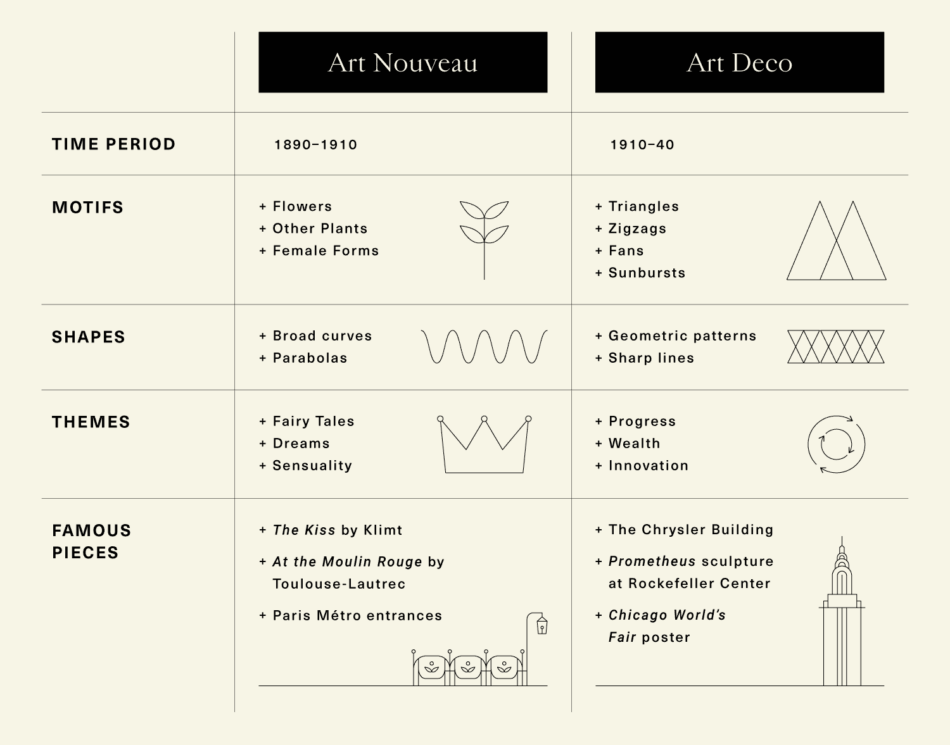
Nevertheless, these ii styles oftentimes get confused. That's understandable, since their periods of popularity overlapped and both were shaped by major earth events. Fine art Nouveau was a reaction to the Industrial Revolution transforming the American and European economies, while Fine art Deco emerged later the global chaos of World State of war I.
Characteristics of Art Nouveau (1890–1910)
Art Nouveau — generally considered to accept begun in the belatedly 1800s and ended with the outset of Earth State of war I — drew inspiration from natural forms, such as trees, flowers and, of course, the homo figure. Information technology is characterized by sweeping curves and a sense of movement, along with the use of modernistic materials similar glass and iron. The mode, a reaction to the bookish, history-based art of the 19th century, emphasized applied arts like jewelry and architecture as opposed to the traditional fine arts of painting and sculpture.
Design Features:
- Floral and other nature-inspired motifs
- Curves and parabolas
- Fairy-tale or otherworldly feeling
- Sensuous and at times scandalous subject thing
Famous Art Nouveau Artists + Examples
The following artists and designers rendered the quintessential themes of Art Nouveau in a variety of mediums and genres.
i. Gustav Klimt (1862–1918)
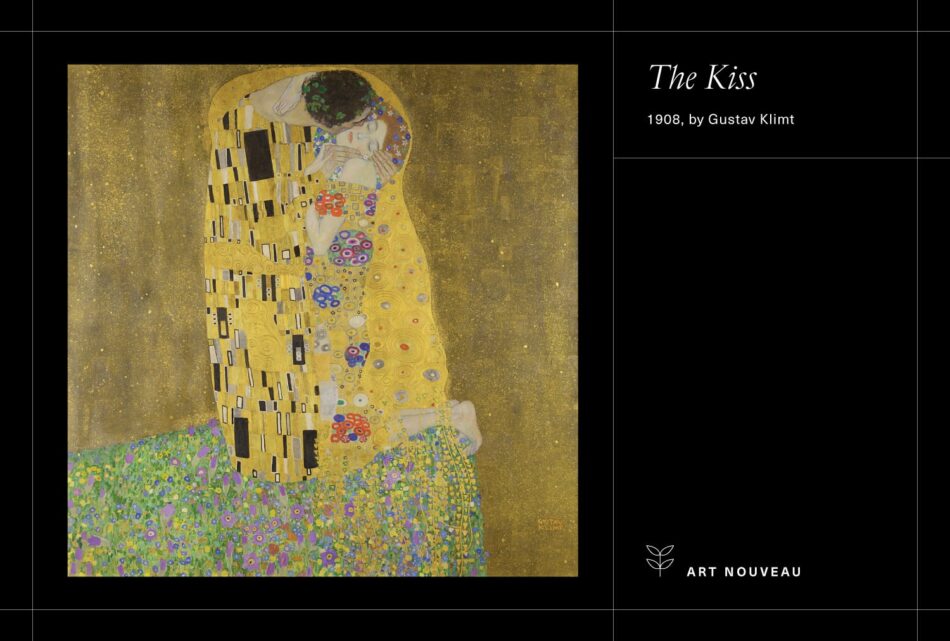
Gustav Klimt'due south oil-paint and gold-leaf masterpiece The Buss, 1908, displays many elements characteristic of Art Nouveau, including the use of metallic, floral designs on the ground and on the woman's clothing and the romantic subject area of a couple intertwined in an embrace.
ii. Alphonse Mucha (1860–1939)
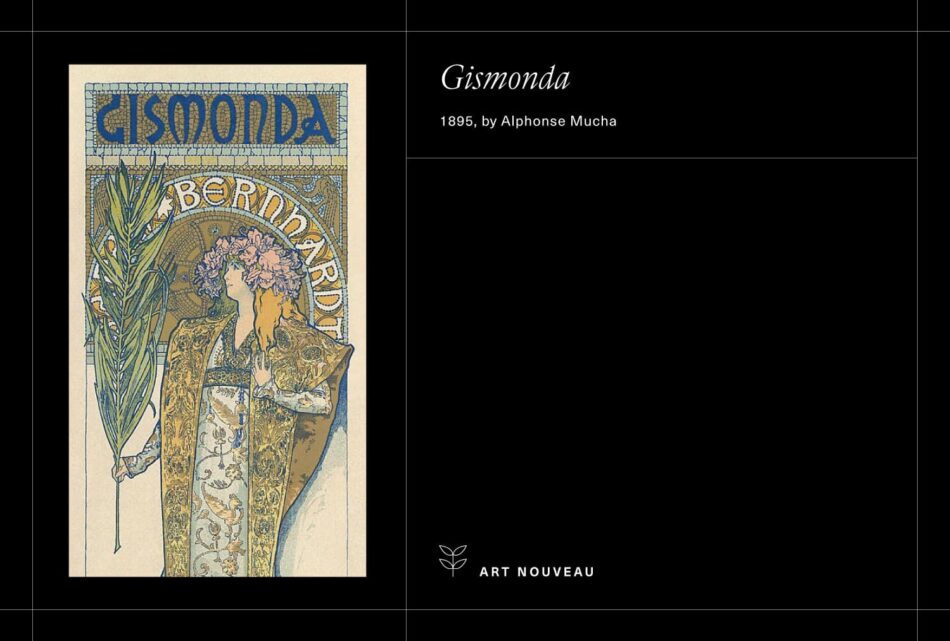
Czech artist Alphonse Mucha helped ascertain the Art Nouveau mode with his posters advertising theatrical productions. These often featured the actress Sarah Bernhardt in otherworldly, magical settings with intricate floral designs.
3. Josef Hoffmann (1870–1956)
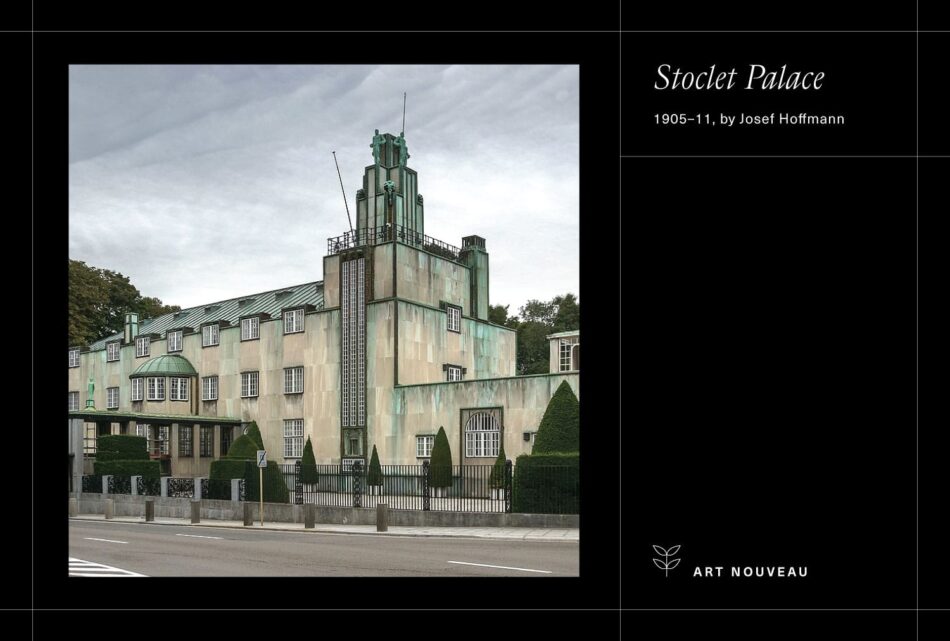
A cofounder of the pioneering Wiener Werkstätte design motility, architect Josef Hoffmann is best known for his piece of work on the Stoclet Palace, in Brussels. The Art Nouveau influence is clearly demonstrated in such architectural elements every bit the numerous parabolic curves; sumptuous, theatrical interiors; and four nude statuary sculptures by Franz Metzner mounted on the tower.
four. Henri de Toulouse-Lautrec (1864–1901)
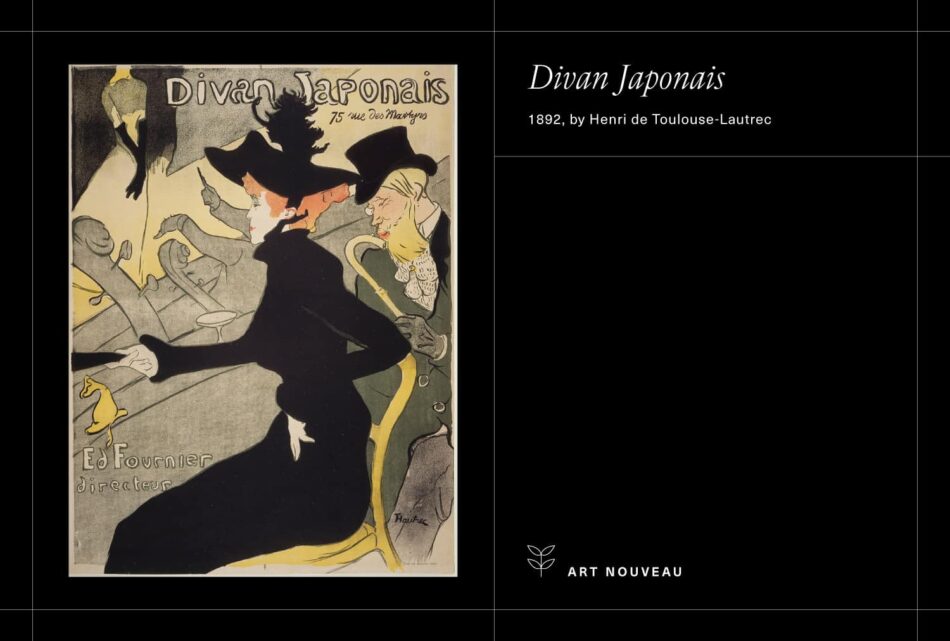
This famous 1892 poster by Henri de Toulouse-Lautrec, promoting the Divan Japonais café in Paris, showcases his distinctive style. Its sweeping curves and sensual depiction of the subjects (from left, singer Yvette Guilbert, dancer Jane Avril and author Édouard Dujardin) are all emblematic of early Art Nouveau.
five. Louis Condolement Tiffany (1848–1933)
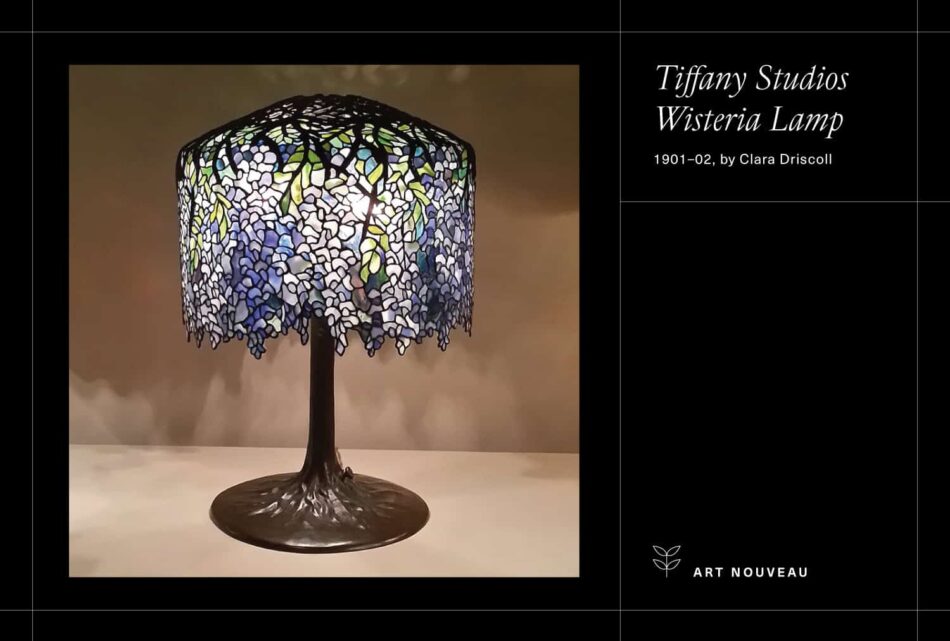
Perhaps the best-known Fine art Nouveau designer is Louis Comfort Tiffany, of the renowned Tiffany Studios. His studio'southward iconic stained-glass lampshades are synonymous with turn-of-the-century luxury and the Art Nouveau motility. Near feature nature-inspired elements, such as floral, butterfly, peacock and dragonfly designs.
Characteristics of Fine art Deco (1910–40)
Art Deco brings to heed New York City skyscrapers, Jay Gatsby'due south lavish parties and swanky speakeasies. Information technology emerged every bit a global design style around the start of Earth War I, during the last years of Art Nouveau'south popularity, and remained dominant until the beginning of Globe War II. The style celebrates the menses's social and technological progress and the earth'south increasing connectedness. Its hallmarks include the employ of expensive materials and geometric designs influenced by Cubism.
Blueprint Features:
- Opulence
- Bold geometric shapes
- Shiny materials like steel and chrome
- Commemoration of innovation, engineering science and wealth
Famous Fine art Deco Artists + Examples
Accept a await at the pieces below to get a feel for Art Deco'due south lavish, geometric style.
1. René Lalique (1860–1945)
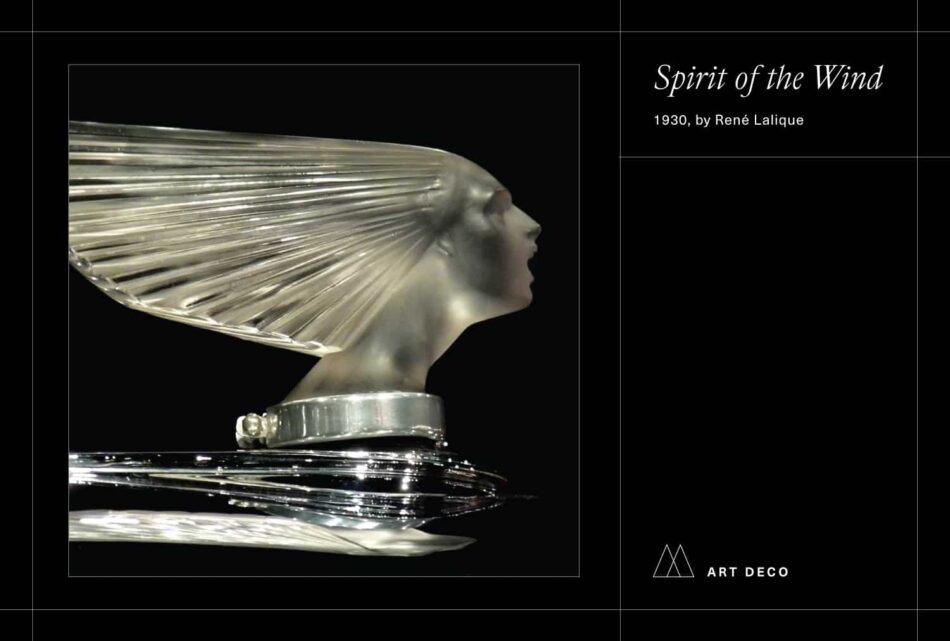
Although René Lalique began his career as an Art Nouveau jewelry designer, he later became known for his glass sculptures in the Art Deco style. The piece in a higher place, Spirit of the Current of air, 1905, was designed as a automobile hood ornament and has been re-created many times. The swept-back straight lines of the Spirit's pilus suggest the speed made possible by innovations in automobile technology.
2. Erté (1892–1990)
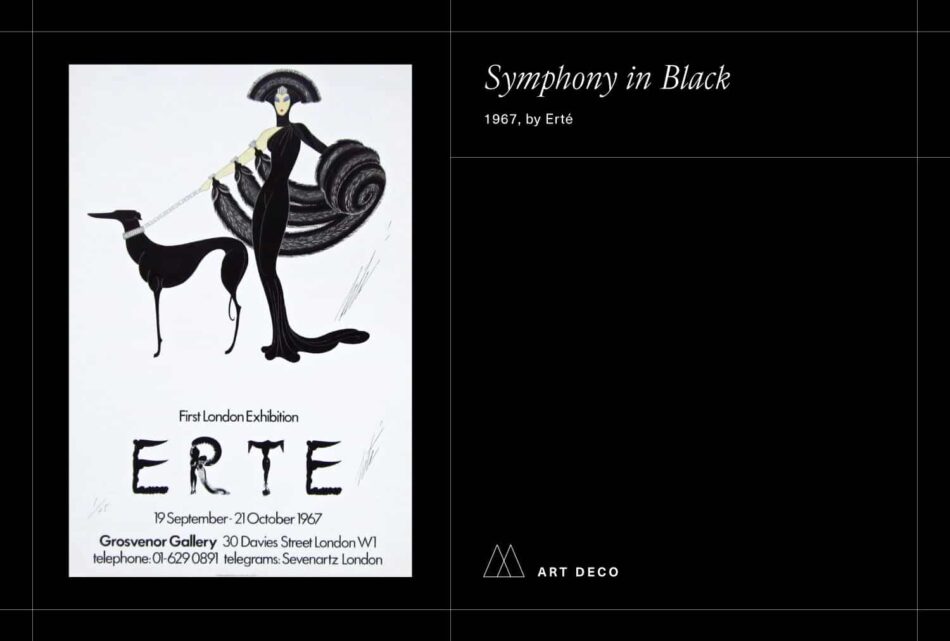
The piece of work of manner designer Erté (born Romain de Tirtoff) divers a genre of costume design and movie posters. He worked on many famous films, including Paris, Ben-Hur and The Restless Sexual practice; he also designed for Broadway shows and lifestyle magazines like Cosmopolitan and Harper's Boutique. Symphony in Black, pictured above, is his most famous work and has been reproduced endless times on posters, dishes, greeting cards, apparel and more. The effigy's sleek, worldly lavishness gear up the tone for Art Deco fashion for years to come. Erté experienced a improvement in the 1980s, even so throughout decades, his way never strayed from its Deco roots.
3. Tamara de Lempicka (1898–1980)
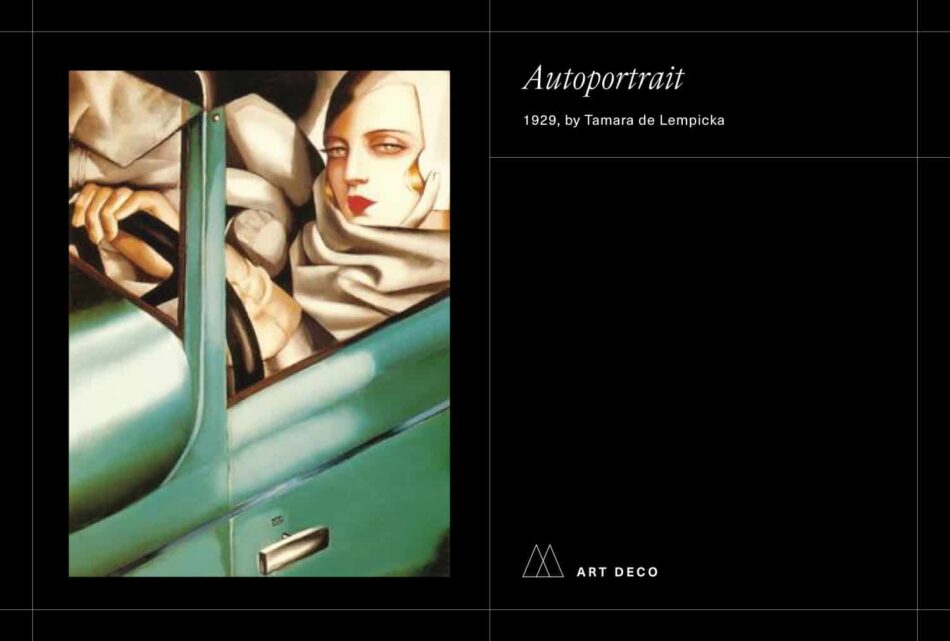
Tamara de Lempicka'due south paintings comprise the central Art Deco themes of luxury and loftier club. She is best known for her striking portraits of aloof patrons and her Cubist-inspired nudes. In the 1929 self-portrait to a higher place, she depicts herself as the platonic Gatsby-era adult female: wealthy, beautiful and caring merely about living the high life.
4. Jean Dunand (1877–1942)
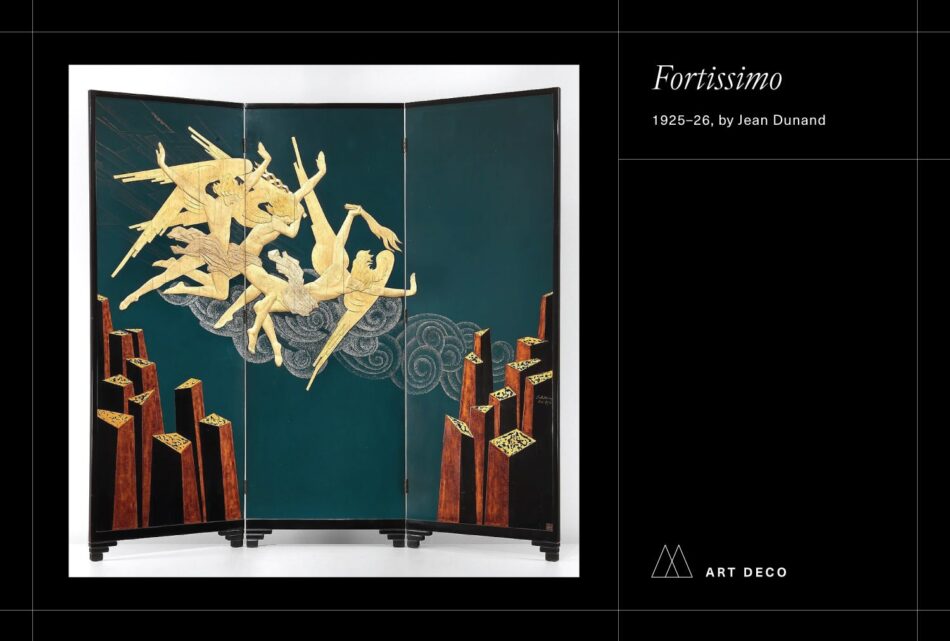
Known primarily for design objects like vases, metal trays and lacquered screens, Jean Dunand also created architectural elements for the sumptuous interiors of luxury apartments and high-stop prowl liners, including extravagantly decorated paneling embodying Art Deco themes. His Fortissimo screen, 1925–26, displays the manner's characteristic hard edges and geometric patterns.
five. Cassandre (1901–68)
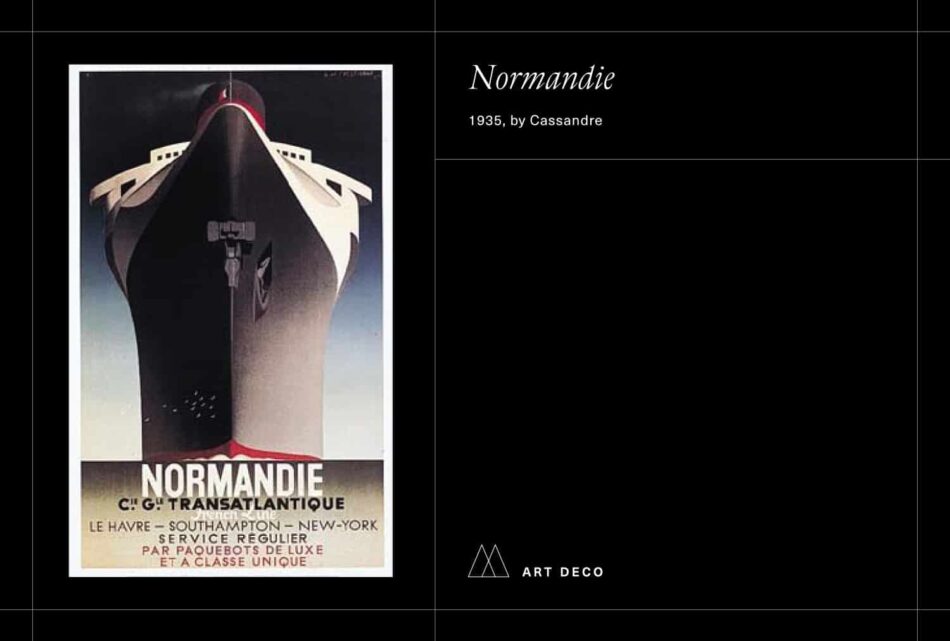
Cassandre (born Adolphe Jean-Marie Mouron) was among the near acclaimed graphic designers of the 1920s and '30s. The era'due south technological innovations inform his piece of work, from his famous affiche ad the SS Normandie, above, to the billboards he designed to be seen from speeding cars, to the fonts he invented, which are still used today.
Fine art Nouveau vs. Art Deco FAQs
If you lot're interested in learning a bit more nearly these ii iconic styles, hither are answers to a few of the most frequently asked questions nigh Art Deco and Art Nouveau.
ane. Is Art Deco an Extension of Art Nouveau?
Some art historians consider Art Deco an extension of Art Nouveau because it shares many features with the earlier manner, such every bit "scandalous" subjects, like nudes and expressions of sexuality, and the utilise of modern materials like metal and glass. Moreover, many artists were associated with both styles, as their work evolved over the decades.
Fine art Deco was influenced by other movements in addition to Art Nouveau — Cubism, Craft and Futurism, for example — then it's often considered a hybrid.
ii. Why Is Art Deco Still Popular Today?
Fine art Deco has the double appeal of reminding us of our past and expressing organized religion in the hereafter. The Roaring Twenties are among the nigh storied modern eras, and Art Deco design recalls the decade's elaborate parties, smoky jazz clubs and fun-loving flappers. At the same time, information technology conveys the pride people in the 1920s and '30s felt in the period'southward social and technological accomplishments and their excitement virtually what lay alee — both of which can inspire us today.
3. Where Is the Biggest Art Deco–Style Sculpture in the World?
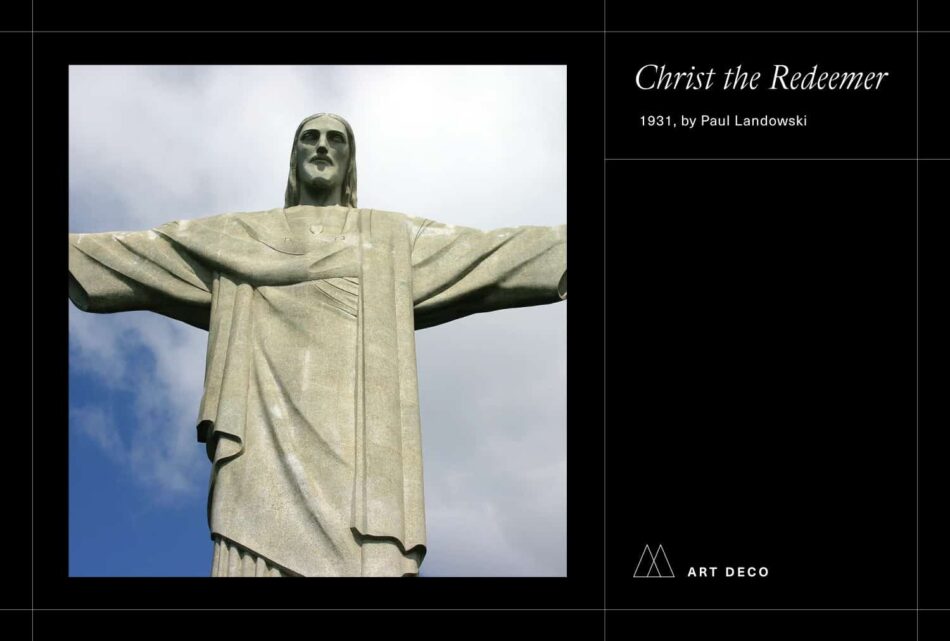
Rio de Janeiro, in Brazil, is home to Christ the Redeemer, the biggest Fine art Deco–mode sculpture. The statue, made of reinforced concrete and continuing 98 feet tall, was completed in 1931, afterward five years of work by a team of designers, artists and engineers, based on a concept by Paul Landowski.
We promise these examples inspire you to commence on your own Art Deco or Fine art Nouveau revival, enlivening your decor with the themes and passions the ii styles so elegantly convey.
Source: https://www.1stdibs.com/blogs/the-study/art-deco-vs-art-nouveau/
0 Response to "Was Artist Mucha Art Deco Christ the Redeemer Art Deco"
Post a Comment