The Work of Art as a Special Space of Contemplation
What is infinite? With this question can start almost any consideration of space in art. The definition of space gives united states of america fiddling to hold onto apropos its characteristics besides that it exists only in relation to something, or someone. Encyclopedia Britannica defines space as "a dizzying, iii-dimensional extent in which objects and events occur and have relative position and management." [one] Position and fifty-fifty direction in art may take some currency in previous ages when fine art had its strictly defined purpose of representing the living or metaphysical world. Nonetheless, even the metaphysical i relied heavily on our perception and imagination, and was made like to the palpable reality. As artistic styles developed and advanced movements took over the art world by storm, space in art started to dissolve and forms that filled artworks were defined along a much simpler differentiation betwixt positive and negative space. While talking virtually the definition of space in fine art, positive stands in this equation for the place occupied past form, while negative is what remains between and around the form'south shapes. Such distinction is non something typical for this period in art history, but is nonetheless taken to the fore, as other spatial differentiation achieved through perspective and depth were non applicable anymore.
Examining space in art must e'er take into account the circuitous social and cultural standings of a given time. Space is not something that was always represented with the pure artistic ideas behind it. Sometimes, the needs coming from the outside of the artistic world influenced the way infinite was understood and depicted. In what follows, we runway some of the changes in its depiction, and give a few examples to stimulate farther thinking well-nigh spatial relations in fine art.
Types and Examples of Space in Art
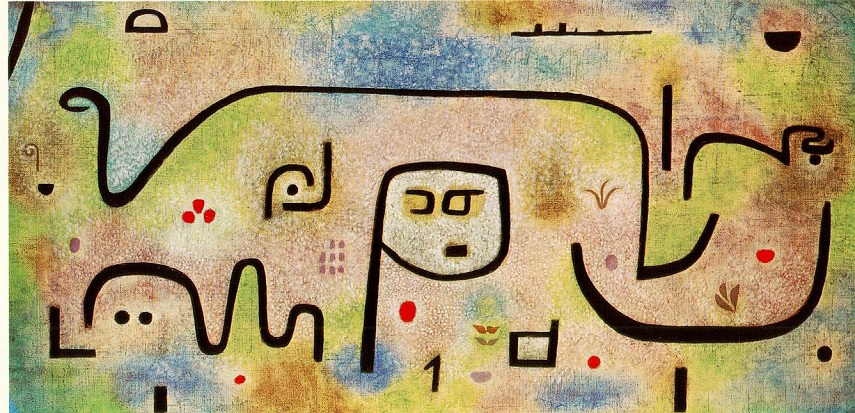
Negative, positive, implied or existent, all these attributes utilise to space and its representation and use in arts. Negative or positive infinite, as mentioned above, is not something that is only applied and used in certain artworks but is a more general differentiation that is applicable to painting, sculpture, installation and other art forms. Possibly the most notable instance of the apply of negative and positive space is Henry Moore 's sculpture that relies on the coaction between negative and positive areas; betwixt total forms and their absenteeism. In installations real infinite is of the utmost importance as information technology often becomes actively engaged in the work, as in the example from the 2015 Japan Pavilion at the Venice Biennale. Chiharu Shiota's The Key in the Mitt installation was meticulously crafted in the pavilion, and its spatial structures influenced the final outlook of the whole slice. The dream-like event the artist achieved through the apply of ruby yarn, keys and boats, engulfs the gallery in the melancholic temper of loss, but besides of opportunity and hope.[2] Implied infinite in paintings is sometimes depicted post-obit the rules of depth and perspective, and sometimes we tin refer to information technology simply in relation to abstract shapes and their compositional arrangement on the sheet. Paul Klee 'southward abstraction, for example, does non possess the spatial orderings as figurative art, merely nonetheless his whimsical shapes and objects are spatially arranged as to create an engaging and dynamic outcome.
Click here to run across bachelor works past Henry Moore on our marketplace!
Metaphysical and Palpable Spaces - From Bernini to Rothko and Troika
Practise you recall Bernini's Ecstasy of St. Teresa? A religious ecstasy visualized in the figure of an angel, the arrow that is nigh to pierce the nun'due south heart, and the golden shower of God'southward beloved. All nicely situated in an elevated aedicule. Space in this Baroque masterpiece is non just relative to the environment where the sculptural figures are situated, but also transcends the immediacy of the palpable expanse to include the metaphysical i, materialized in concrete and recognizable forms. Two spaces and realities merge, just relations that guide our sense of infinite are preserved here. Even the aedicule is engaged in the concluding event of the piece where a small window in the upper part of the architectural element allows light to fall downwards onto Bernini's composition.
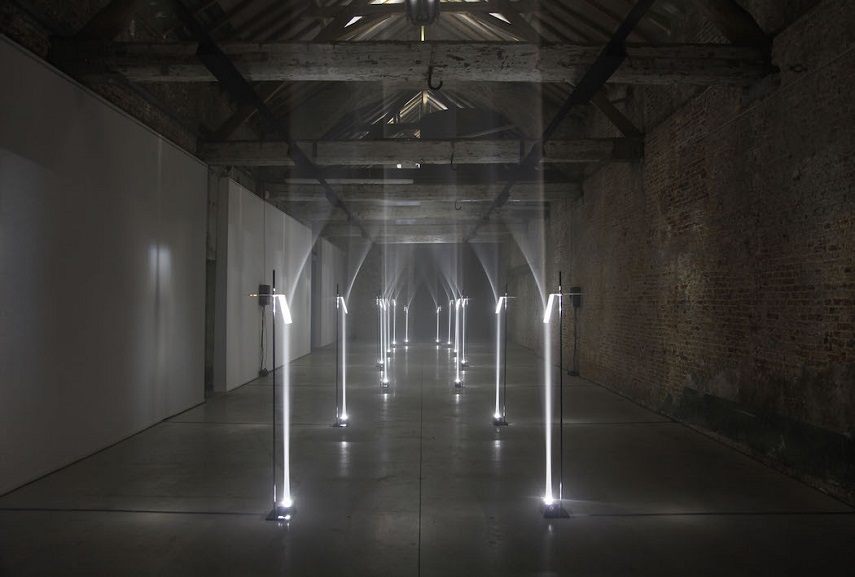
Engaging space to create a metaphysical experience is non unknown to gimmicky artists too. Examples abound form painting, sculpture and installation art. In painting, 1 of the best-known examples is Rothko 's work. On his canvases infinite is flatten-out in splashes of color that should provoke contemplation and induce metaphysical peace. Similarly interested in metaphysical effects of space in art is the London-based artist trio Troika - Eva Rucki, Conny Freyer and Sebastien Noel. In 2012 they fabricated a site-specific architectural installation named Arcades, comprised of light pillars which rays refracted by a fresnel lens created the illusion of gothic arches. Every bit the artists stated: "creating a spatial interruption of disbelief, Arcades encourages an analysis of our relationship with the metaphysical in a globe increasingly governed by practical, rational and scientific principles." [three]
Infinite in Cultural Clashes
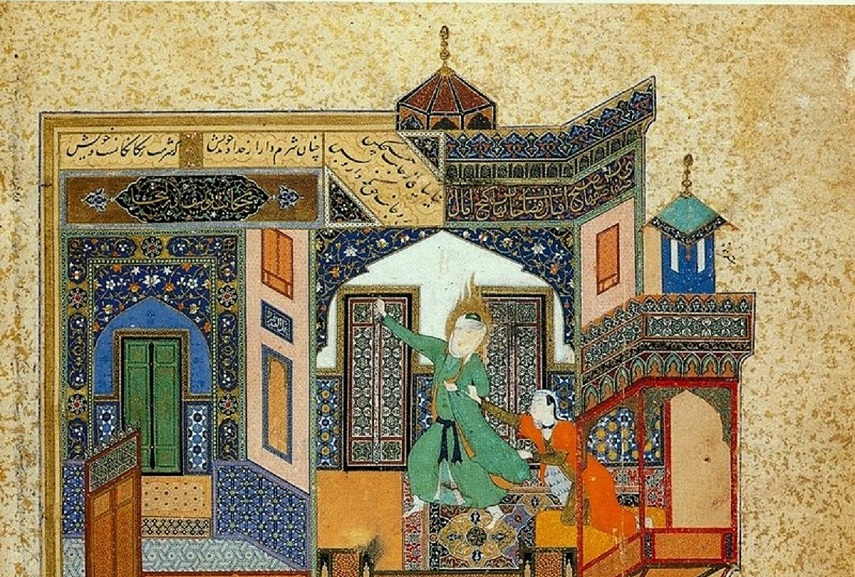
An of import attribute that should non be neglected when space in art or other artistic elements are examined, is its role in the so-chosen cultural clashes, especially during the imperial potency of the Western Europe over dissimilar globe regions and cultures. The manner infinite was represented in arts served as i of the aspects of how artworks were valued, and this was purposefully used in problematic hierarchical orderings. It was ane of the markers that differentiated high fine art from the so-called crafts of "tribal cultures". Not acceptant of the unlike modes of representing reality, Imperialists arrogantly assumed that if space is not nicely rendered in perspective as in their art since the Renaissance, if figures or perspective are not presented in a realistic mode - this testifies to a somewhat lower cultural level of the population that created them. Cartoon from their own by of the center ages and its arts where space was defined along the different lines excluding those of perspective and depth, they linked other forms with like neglect of spatial orderings as backward and intelligible to a rational heed.
Disturbing Our Notions of Space - Modern and Contemporary Art
In the video sample below, fromKubrick'south famous film 2001: Infinite Odyssey, the space is problematized on several levels, starting from the viewer's perspective, to the perspective of actual performers in the moving-picture show. The stability of their position is masterfully put out of residue and gravitational order, just they seem to keep their piece of work unencumbered past this. On the other hand, the viewers are shifted out of their comfort zone and are unable to grasp the spatial relations and orderings presented to them. The chamber of the spaceship in which the activeness takes place in not defined in usual terms that assist us make sense of the identify we are in, or of the place we are observing. What is up, and what is downwardly? Left and right also seem to lose meaning. We are presented with a visual slice which expressiveness relies on the loss of spatial orientation in its observers.
Kubrick'southward Play with Space - 2001: A Space Odyssey
Art That Consumes Space - James Turrell and Anish Kapoor
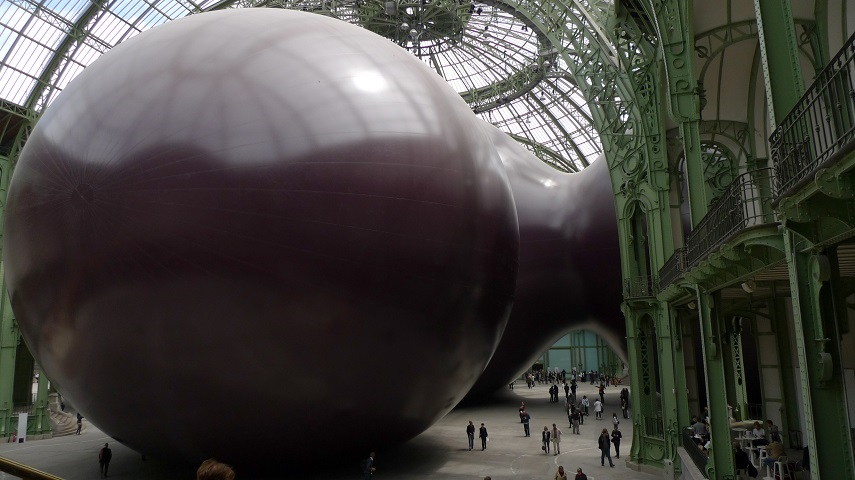
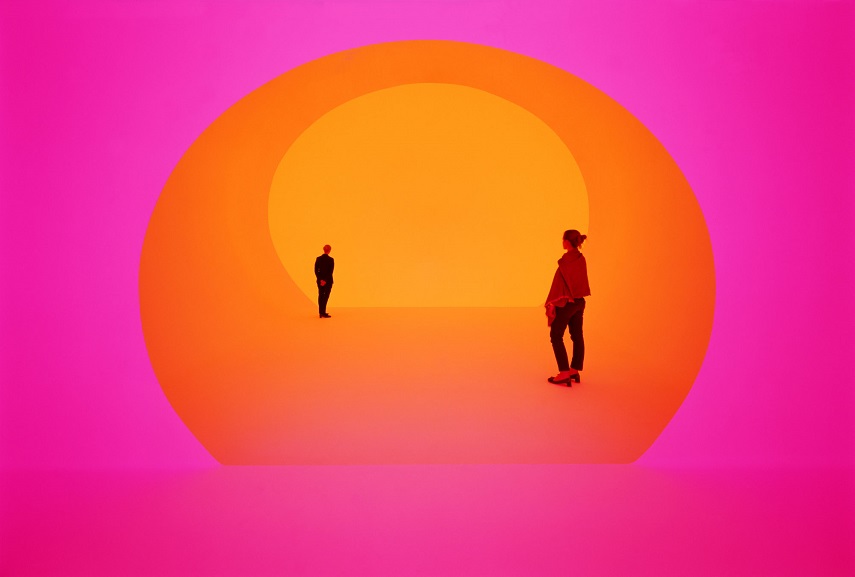
Other examples of space in art that poke at our sense similarly to Kubrick's cult flick come from the world of installation and light art. James Turrell , a well-known and established author focuses on the color and low-cal effects that in interplay with the area in which they are produced create a transcendental result. His take on space may be closely linked with those of abstract artists who shunned the importance of spatial differentiations for the effects pure colour may produce in the observer. Turrell uses places as canvases on which he reproduces colors of such intensity that visually deliquesce physical boundaries. The achieved effect tin can be compared with the physical entering into an abstract painting. While Turrell consumes space with color, Anish Kapoor's Leviathan devours it with its gigantic scale. Situated in the Grand Palais in 2011, this inflatable monumental piece stirs thinking on relations between contemporary art and creative traditions, but as well on our bodies, origins and experiences. For Kapoor Leviathan is "a unmarried object, a single course, a single color" that creates a space within a space, and which hopefully manages"through strictly concrete means, to offer a completely new emotional and philosophical experience." [four]
Interested in the art of Anish Kapoor? Click hither to run across more than works!
Space in Fine art through the Trajectories of Perception
Our short travel through art history shows how space was differently used in creative practices and how important information technology was and nevertheless is to any creative process. Rarely considered but a passive chemical element of an artwork, space is more often an active participant in its evolution, as seen from Shiota's and Turrell's works. Sometimes social and creative conventions influence how information technology is used and represented, merely more usually creatives utilize information technology in order to probe some sedimented artistic and cultural mores, such is the case with Kapoor's and Kubrick'south art. Perception plays an of import function in deciding on how space will be utilized. From the Middle Ages when religious themes were washed in a relatively flat spatial orderings, equally the importance of the motifs surpassed the need for visual veracity, to a Renaissance enkindling to the importance of humanity in the general schemes of the universe, in which axis of our reality became the guiding principle in fine art, to modern and contemporary rejections of hierarchical dominance of whatever worldview, representations of space followed this trajectory in art and remained an important factor in its aesthetics.
Featured images: Chiharu Shiota - The Fundamental in the Hand, 2015. Image via dreamofitaly.com; Sesshū Tōyō - Haboku-Sansui, 1495; Mark Rothko - No.61, Prototype via Widewalls archive. All images used for illustrative purposes but.
References:
- Bearding, Infinite: Physics and Metaphysics , britannica.com [Dec nine, 2016]
- Anonymous, (2015), Chiharu Shiota: "The Key in the Hand" , 2015.veneziabiennale-japanpavilion.jp [December 9, 2016]
- Ker A., (2016), A Metaphysical Exploration Of Light And Infinite , ignant.com [December 9, 2016]
- Anonymous, Monumenta 2011 , marthagarzon.com [December 9, 2016]
Source: https://www.widewalls.ch/magazine/space-in-art
0 Response to "The Work of Art as a Special Space of Contemplation"
Post a Comment