Jackson Pollock National Gallery of Art Print 46 X 34
| Jackson Pollock | |
|---|---|
 Studio portrait at about age xvi | |
| Born | Paul Jackson Pollock (1912-01-28)January 28, 1912 Cody, Wyoming, U.Due south. |
| Died | Baronial 11, 1956(1956-08-11) (anile 44) Springs, New York, U.S. |
| Education | Art Students League of New York |
| Known for | Painting |
| Notable work |
|
| Movement | Abstract expressionism |
| Spouse(s) | Lee Krasner (m. 1945) |
| Patron(due south) | Peggy Guggenheim |
Paul Jackson Pollock (; Jan 28, 1912 – Baronial 11, 1956) was an American painter and a major effigy in the abstract expressionist movement. He was widely noticed for his "drip technique" of pouring or splashing liquid household paint onto a horizontal surface, enabling him to view and paint his canvases from all angles. Information technology was also called all-over painting and action painting, since he covered the entire canvas and used the force of his whole body to paint, oftentimes in a frenetic dancing style. This extreme form of abstraction divided the critics: some praised the immediacy of the creation, while others derided the random effects. In 2016, Pollock'southward painting titled Number 17A was reported to have fetched US$200 million in a individual purchase.
A reclusive and volatile personality, Pollock struggled with alcoholism for most of his life. In 1945, he married the artist Lee Krasner, who became an important influence on his career and on his legacy. Pollock died at the historic period of 44 in an alcohol-related single-auto blow when he was driving. In December 1956, iv months after his expiry, Pollock was given a memorial retrospective exhibition at the Museum of Modernistic Art (MoMA) in New York Metropolis. A larger, more comprehensive exhibition of his work was held at that place in 1967. In 1998 and 1999, his work was honored with big-scale retrospective exhibitions at MoMA and at The Tate in London.[1] [2]
Early life (1912–1936) [edit]
Paul Jackson Pollock was born in Cody, Wyoming, in 1912,[3] the youngest of five brothers. His parents, Stella May (née McClure) and LeRoy Pollock, were born and grew upwards in Tingley, Iowa, and were educated at Tingley Loftier Schoolhouse. Pollock's mother is interred at Tingley Cemetery, Ringgold County, Iowa. His male parent had been built-in with the surname McCoy, but took the surname of his adoptive parents, neighbors who adopted him after his ain parents had died within a yr of each other. Stella and LeRoy Pollock were Presbyterian; they were of Irish and Scots-Irish descent, respectively.[four] LeRoy Pollock was a farmer and later on a land surveyor for the government, moving for different jobs.[3] Stella, proud of her family's heritage every bit weavers, made and sold dresses as a teenager.[5] In November 1912, Stella took her sons to San Diego; Jackson was just ten months erstwhile and would never return to Cody.[5] He subsequently grew up in Arizona and Chico, California.
While living in the Vermont Foursquare neighborhood of Los Angeles, he enrolled at Manual Arts Loftier School,[half dozen] from which he was expelled. He had already been expelled in 1928 from another high school. During his early life, Pollock explored Native American culture while on surveying trips with his male parent.[three] [7] He was also heavily influenced by Mexican muralists, particularly José Clemente Orozco,[8] [9] whose fresco Prometheus he would later call "the greatest painting in N America".[10]
In 1930, following his older brother Charles Pollock, he moved to New York Urban center, where they both studied under Thomas Hart Benton at the Art Students League. Benton'south rural American subject matter had petty influence on Pollock'south piece of work, but his rhythmic employ of pigment and his fierce independence were more than lasting.[3] In the early 1930s, Pollock spent a summer touring the Western United States together with Glen Rounds, a fellow art student, and Benton, their teacher.[xi] [12]
Career (1936–1954) [edit]
Pollock was introduced to the use of liquid paint in 1936 at an experimental workshop in New York Metropolis by the Mexican muralist David Alfaro Siqueiros. He later used paint pouring equally one of several techniques on canvases of the early 1940s, such equally Male and Female person and Composition with Pouring I. After his move to Springs, New York, he began painting with his canvases laid out on the studio floor and he developed what was afterward chosen his "drip" technique.
From 1938 to 1942 Pollock worked for the WPA Federal Fine art Projection.[13] During this fourth dimension Pollock was trying to deal with his established alcoholism; from 1938 through 1941 he underwent Jungian psychotherapy with Dr. Joseph L. Henderson and later on with Dr. Violet Staub de Laszlo in 1941–42. Henderson engaged him through his art, encouraging Pollock to make drawings. Jungian concepts and archetypes were expressed in his paintings.[14] [15] Some historians[ who? ] have hypothesized that Pollock might accept had bipolar disorder.[16] Pollock signed a gallery contract with Peggy Guggenheim in July 1943. He received the commission to create the 8-by-20-foot (2.four by 6.1 m) Mural (1943)[17] for the entry to her new townhouse. At the suggestion of her friend and advisor Marcel Duchamp, Pollock painted the work on sail, rather than the wall, so that information technology would be portable. After seeing the big mural, the art critic Clement Greenberg wrote: "I took i look at it and I thought, 'At present that's great fine art,' and I knew Jackson was the greatest painter this state had produced."[18] The catalog introducing his beginning exhibition described Pollock'due south talent as "volcanic. It has fire. It is unpredictable. It is undisciplined. It spills out of itself in a mineral prodigality, non nevertheless crystallized."[19]
Drip menstruation [edit]
Pollock'southward nearly famous paintings were made during the "drip period" between 1947 and 1950. He became famous following an August 8, 1949, four-folio spread in Life magazine that asked, "Is he the greatest living painter in the United States?" Thanks to the arbitration of Alfonso Ossorio, a shut friend of Pollock, and the art historian Michel Tapié, the young gallery owner Paul Facchetti, from March vii, 1952, managed to realize the first exhibition of Pollock'south works from 1948 to 1951[20] in his Studio Paul Facchetti in Paris and in Europe.[21] At the tiptop of his fame, Pollock abruptly abandoned the drip style.[22] Pollock'southward drip paintings were influenced by the creative person Janet Sobel; the fine art critic Clement Greenberg would later report that Pollock "admitted" to him that Sobel'due south work "had made an impression on him."[23]
Pollock's work later on 1951 was darker in color, including a collection painted in black on unprimed canvases. These paintings have been referred to as his "Black pourings" and when he exhibited them at the Betty Parsons Gallery in New York, none of them sold. Parsons afterward sold one to a friend at one-half the price. These works prove Pollock attempting to find a balance between abstraction and depictions of the effigy.[24]
He later returned to using colour and connected with figurative elements.[25] During this period, Pollock had moved to the Sidney Janis Gallery, a more than commercial gallery; the demand for his piece of work from collectors was smashing. In response to this pressure, forth with personal frustration, his alcoholism deepened.[26]
Relationship with Lee Krasner [edit]
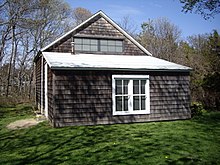
The two artists met while they both exhibited at the McMillen Gallery in 1942. Krasner was unfamiliar yet intrigued with Pollock's work and went to his apartment, unannounced, to meet him following the gallery exhibition.[27] In Oct 1945, Pollock and Lee Krasner were married in a church with two witnesses nowadays for the event.[28] In November, they moved out of the city to the Springs expanse of East Hampton on the southward shore of Long Island. With the aid of a downwards-payment loan from Peggy Guggenheim, they bought a wood-frame house and befouled at 830 Springs Fireplace Road. Pollock converted the barn into a studio. In that space, he perfected his big "drip" technique of working with paint, with which he would go permanently identified. When the couple institute themselves gratis from piece of work they enjoyed spending their time together cooking and baking, working on the house and garden, and entertaining friends.[29]
Krasner'southward influence on her husband's art was something critics began to reassess by the latter half of the 1960s due to the rise of feminism at the fourth dimension.[xxx] Krasner'south extensive knowledge and training in modernistic art and techniques helped her bring Pollock upwardly to appointment with what gimmicky art should be. Krasner is often considered to have tutored her married man in the tenets of modernistic painting.[31] [32] Pollock was and then able to change his manner to fit a more organized and cosmopolitan genre of modern fine art, and Krasner became the one estimate he could trust.[31] [33] At the beginning of the ii artists' marriage, Pollock would trust his peers' opinions on what did or did not work in his pieces.[33] Krasner was as well responsible for introducing him to many collectors, critics, and artists, including Herbert Affair, who would help further his career as an emerging creative person.[34] Art dealer John Bernard Myers in one case said "there would never have been a Jackson Pollock without a Lee Pollock", whereas swain painter Fritz Bultman referred to Pollock as Krasner'southward "creation, her Frankenstein", both men recognizing the immense influence Krasner had on Pollock'south career.[35]
Jackson Pollock'south influence on his wife'south artwork is often discussed by fine art historians. Many people thought that Krasner began to reproduce and reinterpret her married man'south cluttered paint splatters in her own work.[36] In that location are several accounts where Krasner intended to apply her own intuition as a manner to motion towards Pollock'south I am nature technique in lodge to reproduce nature in her fine art.[37]
Afterward years and decease (1955–1956) [edit]

In 1955, Pollock painted Scent and Search, his final ii paintings.[38] He did not paint at all in 1956, but was making sculptures at Tony Smith'due south domicile: constructions of wire, gauze, and plaster.[25] Shaped by sand-casting, they take heavily textured surfaces similar to what Pollock often created in his paintings.[39]
Pollock and Krasner's relationship began to crumble by 1956, owing to Pollock's continuing alcoholism and infidelity involving another artist, Ruth Kligman.[xl] On August 11, 1956, at 10:15 p.m., Pollock died in a single-car crash in his Oldsmobile convertible while driving nether the influence of alcohol. At the time, Krasner was visiting friends in Europe; she abruptly returned on hearing the news from a friend.[xl] One of the passengers, Edith Metzger, was also killed in the accident, which occurred less than a mile from Pollock's habitation. The other passenger, Ruth Kligman, survived.[41] In December 1956, iv months after his death, Pollock was given a memorial retrospective exhibition at the Museum of Modern Fine art (MoMA) in New York Metropolis. A larger, more comprehensive exhibition of his work was held at that place in 1967. In 1998 and 1999, his work was honored with large-calibration retrospective exhibitions at MoMA and at The Tate in London.[1] [ii]
For the remainder of her life, his widow Lee Krasner managed his estate and ensured that Pollock's reputation remained strong despite changing fine art world trends. The couple are buried in Greenish River Cemetery in Springs with a large boulder marking his grave and a smaller one marking hers.
Artistry [edit]
Influence and technique [edit]
The work of Thomas Hart Benton, Pablo Picasso and Joan Miró influenced Pollock.[42] [43] [44] Pollock started using constructed resin-based paints called alkyd enamels, which at that time was a novel medium. Pollock described this utilise of household paints, instead of artist'south paints, equally "a natural growth out of a need".[45] He used hardened brushes, sticks, and even basting syringes as pigment applicators. Pollock's technique of pouring and dripping paint is thought to exist 1 of the origins of the term action painting. With this technique, Pollock was able to achieve his own signature style palimpsest paintings, with paints flowing from his called tool onto the canvas. By defying the convention of painting on an upright surface, he added a new dimension by beingness able to view and employ paint to his canvases from all directions.[46]
I definitive influence on Pollock was the work of the Ukrainian American artist Janet Sobel (1894–1968) (born Jennie Lechovsky).[47] Peggy Guggenheim included Sobel'south work in her The Art of This Century Gallery in 1945.[48] Jackson Pollock and art critic Clement Greenberg saw Sobel's work there in 1946 and later Greenberg noted that Sobel was "a direct influence on Jackson Pollock's drip painting technique".[49] In his essay "American-Type Painting", Greenberg noted those works were the first of all-over painting he had seen, and said, "Pollock admitted that these pictures had made an impression on him".[50]
While painting this style, Pollock moved abroad from figurative representation, and challenged the Western tradition of using easel and brush. He used the force of his whole body to pigment, which was expressed on the big canvases. In 1956, Time magazine dubbed Pollock "Jack the Dripper" due to his painting mode.[51]
My painting does non come from the easel. I adopt to tack the unstretched sail to the hard wall or the floor. I need the resistance of a difficult surface. On the floor I am more at ease. I feel nearer, more function of the painting, since this way I can walk around it, work from the four sides and literally be in the painting.
I go along to go further away from the usual painter's tools such as easel, palette, brushes, etc. I adopt sticks, trowels, knives and dripping fluid paint or a heavy impasto with sand, cleaved glass or other foreign matter added.
When I am in my painting, I'm not aware of what I'm doing. It is only after a sort of "become acquainted" period that I see what I have been about. I accept no fear of making changes, destroying the image, etc., considering the painting has a life of its own. I try to let it come through. It is only when I lose contact with the painting that the outcome is a mess. Otherwise there is pure harmony, an easy give and take, and the painting comes out well.
—Jackson Pollock, My Painting, 1956[52]
Pollock observed Native American sandpainting demonstrations in the 1940s. Referring to his mode of painting on the floor, Pollock stated, "I experience nearer, more than a part of the painting, since this way I can walk round it, piece of work from the four sides and literally be in the painting. This is akin to the methods of the Indian sand painters of the West."[53] Other influences on his drip technique include the Mexican muralists and Surrealist automatism. Pollock denied reliance on "the accident"; he ordinarily had an idea of how he wanted a particular piece of work to appear. His technique combined the movement of his trunk, over which he had command, the gummy flow of paint, the force of gravity, and the absorption of pigment into the sail. It was a mixture of controllable and uncontrollable factors. Flinging, dripping, pouring, and spattering, he would move energetically effectually the canvas, most as if in a trip the light fantastic, and would non terminate until he saw what he wanted to come across.
Austrian artist Wolfgang Paalen's article on totem art of the indigenous people of British Columbia, in which the concept of space in totemist art is considered from an artist's point of view, influenced Pollock as well; Pollock endemic a signed and dedicated copy of the Amerindian Number of Paalen's mag (DYN four–5, 1943). He had also seen Paalen'southward surrealist paintings in an exhibition in 1940.[54] Another strong influence must have been Paalen's surrealist fumage technique, which appealed to painters looking for new ways to depict what was called the "unseen" or the "possible". The technique was once demonstrated in Matta's workshop, about which Steven Naifeh reports, "One time, when Matta was demonstrating the Surrealist technique [Paalen'south] Fumage, Jackson [Pollock] turned to (Peter) Busa and said in a stage whisper: 'I can practise that without the fume.'"[55] Pollock'due south painter friend Fritz Bultman even stated, "It was Wolfgang Paalen who started information technology all."[56]
In 1950, Hans Namuth, a young photographer, wanted to have pictures—both stills and moving—of Pollock at work. Pollock promised to start a new painting especially for the photographic session, but when Namuth arrived, Pollock apologized and told him the painting was finished.

Photographer Hans Namuth extensively documented Pollock's unique painting techniques
Namuth said that when he entered the studio:
A dripping wet canvas covered the unabridged floor ... At that place was complete silence ... Pollock looked at the painting. Then, unexpectedly, he picked upwardly can and paint castor and started to move around the canvas. It was every bit if he of a sudden realized the painting was not finished. His movements, slow at first, gradually became faster and more dance like as he flung black, white, and rust colored paint onto the sail. He completely forgot that Lee and I were there; he did not seem to hear the click of the photographic camera shutter ... My photography session lasted every bit long equally he kept painting, possibly half an hour. In all that time, Pollock did not stop. How could one go on upwards this level of activity? Finally, he said "This is it."
Pollock's finest paintings ... reveal that his all-over line does not give rise to positive or negative areas: we are non fabricated to experience that i office of the canvas demands to be read as figure, whether abstract or representational, against some other office of the sail read as ground. There is not inside or outside to Pollock's line or the infinite through which it moves. ... Pollock has managed to free line not but from its function of representing objects in the world, only also from its chore of describing or bounding shapes or figures, whether abstruse or representational, on the surface of the sail.
—Karmel, 132
From naming to numbering [edit]
Continuing to evade the viewer'southward search for figurative elements in his paintings, Pollock abandoned titles and started numbering his works. He said nigh this, "[Fifty]ook passively and try to receive what the painting has to offer and non bring a subject affair or preconceived idea of what they are to be looking for." His wife said, "He used to give his pictures conventional titles ... but at present he simply numbers them. Numbers are neutral. They brand people expect at a picture for what it is—pure painting."[45]
Critical debate [edit]
Pollock's piece of work has been the bailiwick of important critical debates. Critic Robert Coates one time derided a number of Pollock's works as "mere unorganized explosions of random energy, and therefore meaningless".[57] Reynold's News, in a 1959 headline, said, "This is non fine art—information technology'south a joke in bad gustatory modality."[58] French abstract painter Jean Hélion, on the other paw, remarked on start seeing a Pollock, "Information technology filled out space going on and on because it did not have a outset or end to it."[59] Cloudless Greenberg supported Pollock'due south piece of work on formalistic grounds. It fit well with Greenberg's view of art history equally a progressive purification in form and elimination of historical content. He considered Pollock's work to be the best painting of its twenty-four hours and the culmination of the Western tradition via Cubism and Cézanne to Manet.
In a 1952 commodity in ARTnews, Harold Rosenberg coined the term "activeness painting" and wrote that "what was to go on the canvass was not a motion picture only an result. The big moment came when information technology was decided to paint 'merely to paint'. The gesture on the canvas was a gesture of liberation from value—political, aesthetic, moral." Many people[ who? ] assumed that he had modeled his "activeness painter" paradigm on Pollock.[threescore]
The Congress for Cultural Freedom, an organization to promote American civilisation and values, backed past the Cardinal Intelligence Bureau (CIA), sponsored exhibitions of Pollock's work. Some left-wing scholars, including Eva Cockcroft, accept argued that the United states government and wealthy elite embraced Pollock and abstract expressionism to place the United States in the forefront of global art and devalue socialist realism.[58] [61] Cockcroft wrote that Pollock became a "weapon of the Cold War".[62]
Pollock described his art every bit "move fabricated visible memories, arrested in space".[63]
Legacy [edit]
Influence [edit]
Pollock's staining into raw canvas was adapted by the Color Field painters Helen Frankenthaler and Morris Louis. Frank Stella made "all-over limerick" a hallmark of his works of the 1960s. The Happenings creative person Allan Kaprow, sculptors Richard Serra and Eva Hesse, and many contemporary artists have retained Pollock'south emphasis on the process of creation; they were influenced past his approach to the procedure, rather than the look of his piece of work.[64]
In 2004, I: Number 31, 1950 was ranked the eighth-most influential slice of modernistic art in a poll of 500 artists, curators, critics, and dealers.[65]
In pop culture and media [edit]
In 1960, Ornette Coleman'due south album Free Jazz: A Commonage Improvisation featured a Pollock painting, The White Lite, as its encompass artwork.
In the early 1990s, 3 groups of flick makers were developing Pollock biographical projects, each based on a dissimilar source. The project that at get-go seemed most advanced was a joint venture between Barbra Streisand's Barwood Films and Robert De Niro's TriBeCa Productions (De Niro'southward parents were friends of Krasner and Pollock). The script, by Christopher Cleveland, was to be based on Jeffrey Potter's 1985 oral biography, To a Violent Grave, a collection of reminiscences by Pollock's friends. Streisand was to play the function of Lee Krasner, and De Niro was to portray Pollock. A 2d was to be based on Love Affair (1974), a memoir past Ruth Kligman, who was Pollock's lover in the half dozen months before his death. This was to be directed by Harold Becker, with Al Pacino playing Pollock.[66]
In 2000, the biographical flick Pollock, based on the Pulitzer Prize-winning biography, Jackson Pollock: An American Saga, directed past and starring Ed Harris, was released. Marcia Gay Harden won the Academy Accolade for Best Supporting Actress for her portrayal of Lee Krasner. The flick was the project of Harris, who was nominated for the University Award for Best Histrion. Harris himself painted the works seen in the film.[67] The Pollock-Krasner Foundation did not authorize or collaborate with any product.[66]
In September 2009, the art historian Henry Adams claimed in Smithsonian magazine that Pollock had written his proper noun in his famous painting Mural (1943).[68] The painting is at present insured for Usa$140 million. In 2011, the Republican Iowa State Representative Scott Raecker introduced a neb to force the sale of the artwork, held by the University of Iowa, to fund scholarships, but his bill created such controversy that it was quickly withdrawn.[17] [69]
Art market [edit]
In 1973, Number 11, 1952 (also known as Blue Poles) was purchased by the Australian Whitlam government for the National Gallery of Australia for US$ii million (A$i.3 1000000 at the time of payment). At the time, this was the highest price ever paid for a modernistic painting. The painting is now one of the most popular exhibits in the gallery.[70] It was a centerpiece of the Museum of Modern Art's 1998 retrospective in New York, the first time the painting had been shown in America since its purchase.
In Nov 2006, Pollock's No. five, 1948 became the globe'south most expensive painting, when information technology was sold privately to an undisclosed buyer for the sum of The states$140 1000000. Some other artist record was established in 2004, when No. 12 (1949), a medium-sized drip painting that had been shown in the United States Pavilion at the 1950 Venice Biennale, fetched The states$11.7 million at Christie's, New York.[71] In 2012, Number 28, 1951, i of the artist's combinations of drip and brushwork in shades of silvery gray with red, yellow, and shots of blue and white, also sold at Christie'southward, New York, for Usa$20.5 one thousand thousand—Usa$23 million with fees—within its estimated range of US$xx million to US$30 million.[72]
In 2013, Pollock's Number 19 (1948) was sold by Christie's for a reported US$58,363,750 during an auction that ultimately reached US$495 million total sales in one dark, which Christie's reports as a record to date as the well-nigh expensive auction of contemporary art.[73]
In Feb 2016, Bloomberg News reported that Kenneth C. Griffin had purchased Jackson Pollock's 1948 painting Number 17A for US$200 million, from David Geffen.[74]
Actuality issues [edit]
The Pollock-Krasner Authentication Board was created by the Pollock-Krasner Foundation in 1990 to evaluate newly found works for an upcoming supplement to the 1978 catalogue.[75] In the past, however, the Pollock-Krasner Foundation has declined to be involved in authentication cases.[76]
In 2006, a documentary, Who the *$&% Is Jackson Pollock? was made concerning Teri Horton, a truck driver who bought an abstract painting for v dollars at a thrift store in California in 1992. This piece of work may exist a lost Pollock painting, but its authenticity is debated.
Untitled 1950, which the New York-based Knoedler Gallery had sold in 2007 for $17 million to Pierre Lagrange, a London hedge-fund multimillionaire, was subject to an actuality suit before the Usa Commune Court for the Southern District of New York. Done in the painter'southward classic drip-and-splash mode and signed "J. Pollock", the minor-sized painting (15 by 28 i/two in) was found to contain yellow pigment pigments non commercially available until most 1970.[77] The accommodate was settled in a confidential understanding in 2012.[78]
Fractal estimator assay [edit]
In 1999, physicist and artist Richard Taylor used calculator assay to show similarities between Pollock's painted patterns and fractals (patterns that recur on multiple size scales) found in natural scenery,[79] reflecting Pollock's ain words: "I am nature".[80] His inquiry squad labelled Pollock's fashion fractal expressionism.[81]
In 2003, 24 Pollockesque paintings and drawings were establish in a locker in Wainscott, New York. In 2005, The Pollock-Krasner Foundation requested a fractal analysis to exist used for the first time in an authenticity dispute.[82] [83] [84] [85] [86] Researchers at the University of Oregon used the technique to identify differences between the patterns in the six disputed paintings analyzed and those in 14 established Pollocks.[82] Paint assay of the paintings by researchers at Harvard University showed the presence in one painting of a synthetic pigment that was non patented until the 1980s, and materials in ii others that were not bachelor in Pollock's lifetime.[87] [88]
In 2007, a traveling museum exhibition of the paintings was mounted and was accompanied by a comprehensive book, Pollock Matters, written by Ellen G. Landau, 1 of the four sitting scholars from the old Pollock Krasner Foundation authentication panel from the 1990s, and Claude Cernuschi, a scholar in Abstract Expressionism. In the book, Landau demonstrates the many connections between the family who owns the paintings and Jackson Pollock during his lifetime to place the paintings in what she believes to exist their proper historic context. Landau as well presents the forensic findings of Harvard University and presents possible explanations for the forensic inconsistencies that were found in three of the 24 paintings.[89] [xc] However, the scientist who invented i of the modern pigments dismissed the possibility that Pollock used this paint equally being "unlikely to the betoken of fantasy".[ citation needed ]
Subsequently, over 10 scientific groups accept performed fractal assay on over 50 of Pollock's works.[91] [92] [93] [94] [95] [96] [97] [98] [99] [100] A 2015 study that used fractal analysis as one of its techniques accomplished a 93% success rate distinguishing existent from fake Pollocks.[101] Current research of Fractal Expressionism focuses on human response to viewing fractals. Cognitive neuroscientists have shown that Pollock'southward fractals induce the same stress-reduction in observers as computer-generated fractals and naturally-occurring fractals.[102] [103]
Athenaeum [edit]
Lee Krasner donated Pollock's papers to the Archives of American Art in 1983. They were later archived with her own papers. The Archives of American Fine art also houses the Charles Pollock papers, which include correspondence, photographs, and other files relating to his blood brother Jackson.
A separate arrangement, the Pollock-Krasner Foundation, was established in 1985. The foundation functions as the official estate for both Pollock and his widow, just also nether the terms of Krasner's will, serves "to assist individual working artists of merit with financial need".[104] The U.S. copyright representative for the Pollock-Krasner Foundation is the Artists Rights Social club.[105]
The Pollock-Krasner House and Studio is endemic and administered by the Stony Brook Foundation, a nonprofit affiliate of Stony Brook Academy. Regular tours of the business firm and studio occur from May through October.
List of major works [edit]

Pollock's studio-flooring in Springs, New York, the visual result of being his main painting surface from 1946 until 1953
- (1942) Male and Female Philadelphia Museum of Fine art[106]
- (1942) Stenographic Effigy Museum of Mod Art[107]
- (1942) The Moon Adult female Peggy Guggenheim Drove[108]
- (1943) Mural University of Iowa Museum of Art,[109] given by Peggy Guggenheim[110]
- (1943) The She-Wolf Museum of Modern Art[111]
- (1943) Blue (Moby Dick) Ohara Museum of Art[112]
- (1945) Nighttime Mist Norton Museum of Fine art[113]
- (1945) Troubled Queen Museum of Fine Arts, Boston[114]
- (1946) Eyes in the Heat Peggy Guggenheim Collection, Venice[115]
- (1946) The Key Art Plant of Chicago[116]
- (1946) The Tea Loving cup Collection Frieder Burda[117]
- (1946) Shimmering Substance, from The Sounds In The Grass Museum of Modern Art[118]
- (1947) Portrait of H.M. University of Iowa Museum of Art, given by Peggy Guggenheim.[119]
- (1947) Full Fathom V Museum of Modern Fine art[120]
- (1947) Cathedral Dallas Museum of Art[121]
- (1947) Enchanted Woods Peggy Guggenheim Collection[122]
- (1947) Lucifer The Anderson Collection at Stanford University[123]
- (1947) Sea Change Seattle Art Museum, given past Peggy Guggenheim[124]
- (1948) Painting [125]
- (1948) Number 5 (4 ft x 8 ft) Individual collection
- (1948) Number 8 Neuburger Museum at the State University of New York at Buy
- (1948) Number 13A: Arabesque Yale University Fine art Gallery, New Oasis, Connecticut
- (1948) Composition (White, Black, Blue and Ruddy on White) New Orleans Museum of Art[126]
- (1948) Summertime: Number 9A Tate Modern
- (1948) "Number nineteen"[127]
- (1949) Number i Museum of Contemporary Fine art, Los Angeles[128]
- (1949) Number 3 Hirshhorn Museum and Sculpture Garden, Washington, D.C.
- (1949) Number 10 Museum of Fine Arts, Boston[129]
- (1949) Number 11 Indiana University Art Museum Bloomington, Indiana[130]
- (1950) Number 1, 1950 (Lavander Mist) National Gallery of Art[131]
- (1950) Mural on Indian cherry-red ground, 1950 Tehran Museum of Contemporary Fine art[132]
- (1950) Autumn Rhythm (Number 30), 1950 Metropolitan Museum of Art[133]
- (1950) Number 29, 1950 National Gallery of Canada[134]
- (1950) Number 32, Kunstsammlung Nordrhein-Westfalen, Düsseldorf, BRD[135]
- (1950) One: Number 31, 1950 Museum of Modernistic Art[136] [137]
- (1951) Number 7 National Gallery of Art[138]
- (1951) Black and White (Number 6) San Francisco Museum of Modernistic Art
- (1952) Convergence Albright-Knox Art Gallery[139]
- (1952) Blue Poles: No. 11, 1952 National Gallery of Commonwealth of australia[140]
- (1952) Number 12, 1952 Governor Nelson A. Rockefeller Empire State Plaza Art Drove[141]
- (1953) Portrait and a Dream Dallas Museum of Art[142]
- (1953) Easter and the Totem The Museum of Mod Fine art[143]
- (1953) Ocean Grey Solomon R. Guggenheim Museum[144]
- (1953) The Deep Heart Georges Pompidou[145] [146]
References [edit]
- ^ a b Varnedoe, Kirk; Karmel, Pepe (1998). Jackson Pollock: Essays, Chronology, and Bibliography. Exhibition itemize. New York: The Museum of Modern Art. pp. 315–329. ISBN978-0-87070-069-9.
- ^ a b Horsley, Carter B., Mud Pies, Jackson Pollock, Museum of Modern Art, November i, 1998 to February 2, 1999, The Tate Gallery, London, March 11 to June 6, 1999: "While it is de rigueur to concentrate on the signature works that ascertain an artist's 'style', it is very of import to understand its evolution..."
- ^ a b c d Piper, David (2000). The Illustrated History of Art. London: Chancellor Press. pp. 460–461. ISBN978-0-7537-0179-nine.
- ^ Friedman, B.H. (1995). Jackson Pollock : energy made visible (ane ed.). New York: Da Capo Printing. p. 4. ISBN978-0-306-80664-iii.
- ^ a b Solomon, Deborah (June 26, 2001). Jackson Pollock: A Biography. Cooper Foursquare Printing. pp. 15–16, 21. ISBN9781461624271.
- ^ "Our Lady of Loretto Uncomplicated Schoolhouse: Local History Timeline". Archived from the original on July 15, 2011. Retrieved June 24, 2011.
- ^ Sickels, Robert (2004). The 1940s . Greenwood Publishing Group. p. 223. ISBN978-0-313-31299-1.
- ^ Cotter, Holland (Feb 20, 2020). "How Mexico'due south Muralists Lit a Burn down Under U.S. Artists". The New York Times . Retrieved May xviii, 2020.
- ^ Polcari, Stephen (1992). "Orozco and Pollock: Epic Transfigurations". American Art. 6 (3): 37–57. doi:10.1086/424159. ISSN 1073-9300. JSTOR 3109102. S2CID 194040790.
- ^ "José Clemente Orozco's Prometheus". Pomona Higher . Retrieved May 18, 2020.
- ^ "Glen Rounds". Northward Carolina Literary Hall of Fame. Retrieved September xv, 2014.
- ^ "Malcolm Bluish Society Celebrates 40 Years". ThePilot.com. July 8, 2013. Retrieved September fifteen, 2014.
- ^ "Jackson Pollock". The American Museum of Beat Art. Retrieved September 28, 2007.
- ^ "Abstract Expressionism, Jackson Pollock's "Psychoanalytic Drawings" Paintings". Archived from the original on June xv, 2010. Retrieved July 25, 2010.
- ^ Stockstad, Marilyn (2005). Art History. Upper Saddle River, New Jersey: Pearson Education, Inc. ISBN978-0-13-145527-half-dozen.
- ^ Rothenberg, A. (2001). "Bipolar illness, creativity, and treatment". The Psychiatric Quarterly. 72 (2): 131–147. doi:10.1023/A:1010367525951. PMID 11433879. S2CID 31980246.
- ^ a b Finkel, Jori (June 26, 2012). "Pollock painting to become the Getty touch". Los Angeles Times.
- ^ Jackson Pollock, Landscape (1943) University of Iowa Museum of Art, Iowa Urban center.
- ^ Sweeney, James Johnson, Catalog- Introduction- Pollock'due south Commencement Exhibition, New York, 1943.
- ^ Tapié, Michel; Ossorio, Alfonso (1952). Jackson Pollock. Paris: Paul Facchetti. p. 8. OCLC 30601793.
- ^ Documents and lists of works from the exhibition tin can exist found in the Facchetti Archives with his son Jean-Paul Agosti and in the Kandinsky Library in the Athenaeum of the Middle Pompidou, Paris.
- ^ Jerry Saltz. "The Storm" (reprint). Artnet.com. Retrieved August 30, 2009.
- ^ Grovier, Kelly (March 8, 2022). "Janet Sobel: The woman written out of history". BBC . Retrieved March 10, 2022.
- ^ William Cook, "Jackson Pollock'due south forgotten bleak masterpieces: The 30-year wait for 'black pourings' exhibition", BBC — Arts, June 30, 2015. Retrieved July 8, 2015.
- ^ a b "Biography". Jackson-pollock.com. Retrieved September 28, 2007.
- ^ "Downfall of Pollock", Jackson Pollock website. Retrieved July 23, 2010.
- ^ Hobbs, Robert. Lee Krasner. New York: Abbeville Printing, 1993. pg. seven
- ^ Rose, Barbara. "Krasner|Pollock: A Working Relationship". New York: Grey Art Gallery and Study Centre, 1981. pg. 4
- ^ Rose, Barbara. "Krasner|Pollock: A Working Relationship". New York: Greyness Art Gallery and Report Center, 1981. pg. viii.
- ^ Tucker, Marcia. "Lee Krasner: Large Paintings". New York: Whitney Museum of American Fine art, 1973. pg.vii
- ^ a b Rose, Barbara. "Krasner|Pollock: A Working Relationship". New York: Greyness Art Gallery and Study Heart, 1981. pg. vi
- ^ Naifeh, Steven Westward.; Smith, Gregory White (December 24, 1989). Jackson Pollock: an American saga. C.Northward. Potter. ISBN978-0-517-56084-6 . Retrieved May iv, 2013.
- ^ a b Berger, John. "Portraits: John Berger on Artists". London: Verso, 2015. pg. 369
- ^ Landau, Due east.1000., Cernuschi, C. "Pollock Matters". Boston: McMullen Museum of Fine art Boston College, 2007. pg. 19
- ^ Chave, Anna. "Pollock and Krasner: Script and Postscript". The President and Fellows of Harvard Higher acting through the Peabody Museum of Archaeology and Ethnology, 1993. Anthropology and Aesthetics, No. 24, pg. 95
- ^ Wagner, Anne M. "Lee Krasner every bit L.K.", Representations, No. 25 (Winter, 1989): 42-57. Print. pg. 44
- ^ Anne M Wagner. Three Artists (3 Women): Modernism and the Art of Hesse, Krasner, and O'Keeffe. (Berkeley: University of California, 1996.) p. 107
- ^ Abstruse Expressionism in 1955 Archived Baronial 25, 2017, at the Wayback Machine. Retrieved Baronial 28, 2009.
- ^ "Jackson Pollock & Tony Smith: Sculpture, An Exhibition on the Centennial of their Births, September 7 - October 27, 2012", Matthew Marks Gallery, New York.
- ^ a b Rose, Barbara. Lee Krasner: A Retrospective. New York: The Museum of Mod Art, 1983. pg. 95
- ^ Varnedoe, Kirk and Karmel, Pepe, Jackson Pollock: Essays, Chronology, and Bibliography, Exhibition itemize, New York: The Museum of Modernistic Art, Chronology, p. 328, 1998, ISBN 0-87070-069-3
- ^ Karmel, Pepe (1999). Jackson Pollock: Interviews, Articles, and Reviews. In Conjunction with the Exhibition "Jackson Pollock"... The Museum of Mod Fine art, New York, November 1, 1998 to February two, 1999. The Museum of Modern Art. pp. 151–. ISBN978-0-87070-037-viii . Retrieved May 4, 2013.
- ^ Johnson, Caitlin A. (January 18, 2007). "Picasso'southward Influence On American Artists". CBS Sunday Morn.
- ^ Emmerling, Leonard (2003). Jackson Pollock, 1912-1956. Taschen. pp. 48–. ISBN978-three-8228-2132-nine . Retrieved May 4, 2013.
- ^ a b Boddy-Evans, Marion. "What Pigment Did Pollock Utilize?". nearly.com. Retrieved September 28, 2007.
- ^ Landau, E.K. (2014). Jackson Pollock's Landscape: The Transitional Moment. Norway: J. Paul Getty Museum. p. 8. ISBN9781606063231.
- ^ "Janet Sobel (1894-1968)". Hollis Taggart Galleries. Archived from the original on July 12, 2011. Retrieved Dec 2, 2018.
- ^ Bob Duggan. "Mother of Invention". Big Call up.
- ^ Cooke, Lynne (2018). Outliers and American vanguard art. National Gallery of Art (U.S.), University of Chicago Press. Washington. ISBN9780226522272. OCLC 975487095.
- ^ Karmel, Pepe (1999). Jackson Pollock: Interviews, Articles, and Reviews. In Conjunction with the Exhibition "Jackson Pollock" - The Museum of Mod Art, New York, November one, 1998 to Feb 2, 1999. The Museum of Modern Art. p. 273. ISBN978-0-87070-037-eight . Retrieved May 4, 2013.
- ^ "The Wild Ones". Time (magazine). Feb twenty, 1956. Archived from the original on November 17, 2007. Retrieved September 15, 2008.
- ^ Jackson Pollock (1999). Jackson Pollock: Interviews, Manufactures, and Reviews. The Museum of Modern Art. p. 17. ISBN978-0-87070-037-8.
- ^ Jackson Pollock, "My Painting", in Pollock: Painting (edited past Barbara Rose), New York: Agrinde Publications Ltd (1980), p. 65; originally published in Possibilities I, New York, Winter 1947-48
- ^ "In United mexican states City, he [Motherwell] visited Wolfgang Paalen whose testify Baziotes and Jackson [Pollock] had seen at the Julien Levy Gallery the yr before." Steven Naifeh, p. 414.
- ^ Steven Naifeh, p. 427.
- ^ Steven Naifeh, p. 534.
- ^ Steven McElroy, "If Information technology'due south Then Easy, Why Don't You Try Information technology", The New York Times, December 3, 2010.
- ^ a b "Expression of an age". Pubs.socialistreviewindex.org.united kingdom of great britain and northern ireland. Retrieved Baronial xxx, 2009.
- ^ Grey Martin, Quote in Book One 'Breaking the Ice' of 'Jackson Pollock — Memories arrested in Space', Santa Monica Press, 2003, ISBN 1891661329
- ^ MacAdam, Barbara A. (November 1, 2007). "Tiptop Ten ARTnews Stories: 'Not a Moving picture but an Result'". ARTnews.com . Retrieved March 23, 2021.
- ^ Saunders, F. Due south. (2000), The Cultural Cold War. The CIA and the World of Arts and Messages, New York: Complimentary Press.
- ^ Eva Cockcroft, "Abstruse Expressionism, Weapon of the Common cold War", Artforum, vol. 12, no. 10, June 1974, pp. 43–54.
- ^ Text written by Pollock on the reverse of a photo of himself, taken in his studio, circa 1948/49
- ^ "Jackson Pollock's Unique Style".
- ^ Higgins, Charlotte (December 2, 2004). "Work of art that inspired a movement ... a urinal". The Guardian . Retrieved July 20, 2014.
- ^ a b Carol Strickland (July 25, 1993), "Race Is On to Portray Pollock", The New York Times.
- ^ Interview with Ed Harris at DVDtalk
- ^ smithsonianmag.com, Henry Adams, "Decoding Jackson Pollock", Smithsonian Magazine, September 2009.
- ^ Michael Winter (February nine, 2011), "Iowa lawmaker proposes selling Pollock masterpiece to fund scholarships", USA Today.
- ^ "Our Poles globe's elevation-priced painting?". The Canberra Times. November 4, 2006. Archived from the original on Oct 14, 2007. Retrieved December ii, 2018.
- ^ Jackson Pollock, No. 12 (1949) Christie's New York, May 11, 2004.
- ^ Ballad Vogel (May 8, 2012), "Record Sales for a Rothko and Other Art at Christie'due south", The New York Times.
- ^ Vartanian, Hrag (May sixteen, 2013). "Historic Night at Christie'southward as 12 Post-War Artists Ready Records, Biggest Sale in History". Hyperallergic. Retrieved May eighteen, 2013.
- ^ "Billionaire drops $500M for two masterpieces", February 19, 2016, Bloomberg News, as republished by Pull a fast one on News, at foxnews.com.
- ^ Lesley M. M. Blume (September 2012), "The Canvass and the Triangle", Vanity Off-white.
- ^ Randy Kennedy (May 29, 2005), "Is This a Real Jackson Pollock?", The New York Times.
- ^ Michael Shnayerson (May 2012), "A Question of Provenance", Vanity Off-white.
- ^ Patricia Cohen (October 21, 2012), "Lawsuits Claim Knoedler Made Huge Profits on Fakes", The New York Times.
- ^ Taylor, Richard; Micolich, Adam; Jonas, David (1999). "Fractal analysis of Pollock's drip paintings". Nature. 399 (422): 422. Bibcode:1999Natur.399..422T. doi:10.1038/20833. S2CID 204993516.
- ^ Schjeldahl, Peter (July 23, 2006). "American Abstruse". The New Yorker. New York City: Condé Nast. Retrieved April 18, 2022.
- ^ R.P. Taylor, "Social club in Pollock's Chaos", Scientific American, vol. 287, 116–121 (2002)
- ^ a b J. Abbott, "In the Easily of a Chief", Nature, vol. 439, 648–650 (2006).
- ^ R.P. Taylor et al, "Authenticating Pollock Paintings Using Fractal Geometry", Pattern Recognition Letters, vol. 28, 695–702 (2005).
- ^ J. Rehmeyer, "Fractal or Fake?", ScienceNews, vol. 171, 122–123, (2007)
- ^ Grand. Jones-Smith et al, "Fractal Analysis: Revisiting Pollock's Paintings" Nature, Brief Communication Arising, vol. 444, E9-10, (2006).
- ^ R.P. Taylor et al, "Fractal Analysis: Revisiting Pollock's Paintings" Nature, Brief Communication Arising, vol. 444, E10-11, (2006)
- ^ Custer, Lee Ann W. (January 31, 2007), "Paint Could Undo Pollock", The Harvard Crimson.
- ^ McGuigan, Cathleen (August xx–27, 2007). "Seeing Is Believing? Is this a existent Jackson Pollock? A mysterious trove of pictures rocks the art world". Newsweek. Archived from the original on Baronial 17, 2007. Retrieved Baronial 30, 2009.
- ^ Ellen Grand. Landau, Claude Cernuschi (2007). Pollock Matters. McMullen Museum of Art Boston Higher, published past the University of Chicago Press.
- ^ Michael Miller (December 7, 2007). "Pollock Matters, The McMullen Museum of Art, Boston College, September 1–December 9, 2007". The Berkshire Review, An International Periodical for the Arts.
- ^ J.R. Mureika, C.C. Dyer, One thousand.C. Cupchik, "Multifractal Construction in Nonrepresentational Art", Physical Review E, vol. 72, 046101-1-fifteen (2005).
- ^ C. Redies, J. Hasenstein and J. Denzler, "Fractal-Like Epitome Statistics in Visual Art: Similar to Natural Scenes", Spatial Vision, vol. 21, 137–148 (2007).
- ^ Southward. Lee, S. Olsen and B. Gooch, "Simulating and Analyzing Jackson Pollock's Paintings" Journal of Mathematics and the Arts, vol.one, 73–83 (2007).
- ^ J. Alvarez-Ramirez, C. Ibarra-Valdez, E. Rodriguez and 50. Dagdug, "i/f-Noise Structure in Pollock's Drip Paintings", Physica A, vol. 387, 281–295 (2008).
- ^ D.J. Graham and D.J. Field, "Variations in Intensity for Representative and Abstract Art, and for Art from Eastern and Western Hemispheres", Perception, vol. 37, 1341–1352 (2008).
- ^ J. Alvarez-Ramirez, J. C. Echeverria, E. Rodriguez "Performance of a High-Dimensional R/Due south Assay Method for Hurst Exponent Estimation", Physica A, vol. 387, 6452–6462 (2008).
- ^ J. Coddington, J. Elton, D. Rockmore and Y. Wang, "Multi-fractal Assay and Hallmark of Jackson Pollock Paintings", Proceedings SPIE, vol. 6810, 68100F 1-12 (2008).
- ^ 1000. Al-Ayyoub, G. T. Irfan and D.Chiliad. Stork, "Boosting Multi-Feature Visual Texture Classifiers for the Authentification of Jackson Pollock'southward Baste Paintings", SPIE proceedings on Calculator Vision and Epitome Assay of Fine art II, vol. 7869, 78690H (2009).
- ^ J.R. Mureika and R.P. Taylor, "The Abstract Expressionists and Les Automatistes: multi-fractal depth", Signal Processing, vol. 93 573 (2013).
- ^ L. Shamar, "What Makes a Pollock Pollock: A Machine Vision Approach", International Journal of Arts and Engineering science, vol. 8, 1–x, (2015).
- ^ L. Shamar, "What Makes a Pollock Pollock: A Machine Vision Approach", International Periodical of Arts and Applied science, vol. 8, 1–ten, (2015)
- ^ R.P. Taylor, B. Spehar, P. Van Donkelaar and C.M. Hagerhall, "Perceptual and Physiological Responses to Jackson Pollock'south Fractals", Frontiers in Human Neuroscience, vol. v 1–13 (2011)
- ^ R.P. Taylor et al, in Fractal Geometry of the Brain, Springer 2016
- ^ "The Pollock-Krasner Foundation website: Press Release page". Pkf.org. Archived from the original on June eleven, 2015. Retrieved August 30, 2009.
- ^ "Near oftentimes requested artists list of the Artists Rights Gild". Arsny.com. Archived from the original on February half dozen, 2015. Retrieved August xxx, 2009.
- ^ "Male and Female" (jpeg). ibiblio.org.
- ^ "Stenographic Figure" (jpeg). ibiblio.org.
- ^ "Drove Online". guggenheim.org. January 1942.
- ^ "UIMA: Mural". Uiowa.edu. Retrieved Baronial xxx, 2009.
- ^ Academy of Iowa Museum of Art (July 1, 2012). "Pollock's "Landscape" Moves to the Getty for a Makeover!". UIMA. Archived from the original on March 12, 2013. Retrieved March 26, 2013.
- ^ "The She-Wolf" (jpeg). ibiblio.org.
- ^ "Blueish (Moby Dick)" (jpeg). ibiblio.org.
- ^ "Norton Museum of Art | History".
- ^ "Troubled Queen". mfa.org. Archived from the original on March 10, 2007.
- ^ "Collection Online". guggenheim.org. Jan 1946.
- ^ "The Key" (jpeg). ibiblio.org.
- ^ "The Tea Loving cup" (jpeg). ibiblio.org.
- ^ "Shimmering Substance" (jpeg). ibiblio.org.
- ^ "Portrait of H.One thousand." digital.lib.uiowa.edu.
- ^ "Full Fathom Five" (jpeg). ibiblio.org.
- ^ "Jackson Pollock - Painting - Cathedral". Beatmuseum.org. Retrieved February 7, 2005.
- ^ "Drove Online". guggenheim.org. January 1947.
- ^ Baker, Kenneth (June fourteen, 2011). "Anderson Gallery a major art donation to Stanford". San Francisco Relate . Retrieved June 14, 2011.
- ^ "Online Drove". art.seattleartmuseum.org/.
- ^ "Painting". centrepompidou.fr. Archived from the original (jpeg) on March eighteen, 2006.
- ^ "New Orleans Museum of Art Educational Guide" (PDF). noma.org. Archived from the original (PDF) on July 3, 2010.
- ^ France-Presse, Agence. "Jackson Pollock work "Number 19, 1948" sells for record $58.4 million at Christie's More Data (Copyright © artdaily.org)". Artdaily.org. Retrieved May xviii, 2013.
- ^ "Number 1". moca.org.
- ^ "Number x". mfa.org. Archived from the original on March xix, 2007.
- ^ "Indiana Academy Art Museum Learning to Look educational web module".
- ^ "Number 1, 1950 (Lavander Mist)" (jpeg). ibiblio.org.
- ^ "Landscape on indian crimson footing, 1950". artcyclopedia.com. Archived from the original on July 18, 2012.
- ^ "Autumn Rhythm (Number xxx)". The Metropolitan Museum of Art, New York. Retrieved August 30, 2009.
- ^ "Creative person Page: Jackson Pollock". Cybermuse.gallery.ca. Archived from the original on May 5, 2009. Retrieved Baronial xxx, 2009.
- ^ "Jackson Pollock: Number 32, 1950". artchive.com.
- ^ "One: Number 31, 1950". MoMA. Retrieved August 30, 2009.
- ^ A Pollock Restored, a Mystery Revealed May 27, 2013 NYT
- ^ "Number vii, 1951 - Image". Nga.gov. Retrieved September 22, 2020.
- ^ "Convergence". albrightknox.org. Archived from the original on November 15, 2006.
- ^ "Bluish poles". Nga.gov.au. Retrieved August 30, 2009.
- ^ "Empire Country Plaza Art Collection".
- ^ Jones, Jonathan (July five, 2003). "Portrait and a Dream". The Guardian. London. Retrieved August xxx, 2009.
- ^ "Easter and the Totem" (jpeg). ibiblio.org.
- ^ "Ocean Gray". Solomon R. Guggenheim Museum: Collection Online. January 1953.
- ^ Jackson Pollock. "The Deep - Jackson Pollock - WikiArt.org". wikipaintings.org.
- ^ "Jackson Pollock: The Deep". artchive.com.
Further reading [edit]
- Herskovic, Marika (2009). American Abstract and Figurative Expressionism Style Is Timely Art Is Timeless An Illustrated Survey With Artists' Statements, Artwork and Biographies. New York School Printing. pp. 127, 196–9. ISBN978-0-9677994-two-1. OCLC 298188260.
- Herskovic, Marika (2003). American Abstruse Expressionism of the 1950s An Illustrated Survey. New York School Printing. pp. 262–5. ISBN978-0-9677994-1-4. OCLC 50253062.
- Herskovic, Marika (2000). New York School Abstract Expressionists Artists Choice by Artists. New York School Press. pp. 18, 38, 278–81. ISBN978-0-9677994-0-7. OCLC 50666793.
- Karmel, Pepe; Varnedoe, Kirk, eds. (1999). Jackson Pollock: Fundamental Interviews, Articles and Reviews. Museum of Modern Art. ISBN978-0-87070-037-8.
- Varnedoe, Kirk; Karmel, Pepe (1998). Jackson Pollock: Essays, Chronology, and Bibliography. Exhibition itemize. New York: The Museum of Modern Fine art. ISBN978-0-87070-069-9.
- O'Connor, Francis V. (1967). Jackson Pollock [exhibition catalogue]. New York: Museum of Modern Art. OCLC 165852.
- Taylor, Richard; Micolich, Adam; Jonas, David (Oct 1999). "Fractal Expressionism". Physics World. 12 (10): 25–28. doi:10.1088/2058-7058/12/ten/21. Archived from the original on August 5, 2012. Retrieved September eighteen, 2015.
- Naifeh, Steven; Smith, Gregory White (1989). Jackson Pollock: an American saga . Clarkson Due north. Potter. ISBN978-0-517-56084-vi.
- Smith, Roberta (February 15, 2002). "Fine art in Review". The New York Times.
- mcah.columbia.edu
External links [edit]
- Exhibition-'Memories Arrested' 2012
- Pollock-Krasner House and Written report Center
- Pollock-Krasner Foundation
- Pollock and The Police force
- National Gallery of Art web feature, includes highlights of Pollock's career, numerous examples of his piece of work, photographs and movement footage of Pollock, plus an in-depth discussion of his 1950 painting Lavender Mist
- Blue Poles at the NGA
- Fractal Expressionism – the fractal qualities of Pollock's drip paintings.
- Jackson Pollock Papers at the Smithsonian'south Archives of American Art
- "Jackson Pollock, John Cage and William Burroughs", talk at MOMA
- pictures of Pollock, slideshow Life Magazine
- Works by Jackson Pollock (public domain in Canada)
Museum links
- Jackson Pollock at the Museum of Modern Art
- The Solomon R. Guggenheim Foundation
- Los Angeles County Museum of Art (LACMA), Los Angeles, California
- Museum of Gimmicky Fine art (MOCA), Los Angeles, California
- Jackson Pollock at the Israel Museum, Jerusalem
Source: https://en.wikipedia.org/wiki/Jackson_Pollock
0 Response to "Jackson Pollock National Gallery of Art Print 46 X 34"
Post a Comment