Art in South Africa During Imperialsim Art in South Africa During Imperialism
Easily recognised past depictions of people with colonial era items and animals - including guns, horses and European-style clothing – colonial era rock art was one time thought to exist the work of San painters capturing the inflow of European colonists on the landscape.
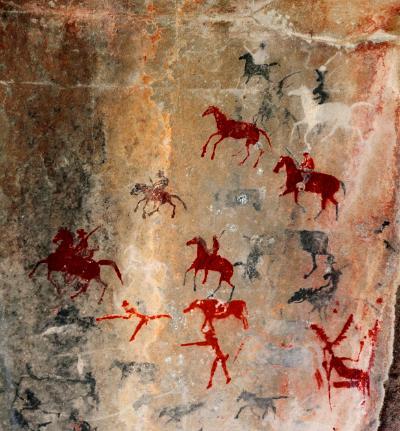 When the informed approach, wherein the use of recorded beliefs of San people was used to decipher rock fine art, was developed, rock art researchers believed that the San painters incorporated the colonists into their cosmological beliefs. Accordingly, the Europeans were understood to be malignant forces that could be fought in both the spirit globe by shamans as well as on the landscape.
More recent research, nonetheless, has made greater use of historical texts, written by settlers, travellers and missionaries, to gain a more than consummate agreement of these groups, an understanding which makes greater sense when read alongside the appearance of the art. To begin with, these texts describe in neat detail the resistance of groups to European colonisation. In many cases these groups were non just San, merely also included Khoe, African farmers and even runaway slaves from the colony, too every bit whatever mixture of these and their descendants. This mixed-nature is reflected in the art itself. The paintings are sometimes fabricated with the fine-line technique characteristic of earlier San art. In other instances they are finger-painted, like the fine art of pastoralists and African farmers. They can also exist painted in crude brushwork, and in some cases combine all three techniques into the aforementioned image!
A closer reading of historical texts also makes it clear that we cannot look at stone art images of people with horses, hats and guns or European-style dresses and be sure that they are indeed depictions of Europeans. Many Africans adopted these items and animals during the colonial flow. That we so often meet rock art of people with hats and guns riding horses, seemingly chasing livestock, makes sense when nosotros consider that mixed groups of Africans often resisted colonial expansion by raiding the animals of European settlers.
Additionally, other-worldly animals, such as the pelting animal plant in earlier San fine art, are likewise ofttimes depicted in these images. Information from African sources reveals that the rain was called upon during livestock raids to assist the raiders every bit mist acted every bit a cover-up and the rain would wash abroad the tracks of animals that had been taken, making it very difficult for whatever pursuers to follow the resistors. Nosotros also see depictions of other animals that would be seemingly out of place were these images the simple depictions of events that actually took place. Baboons and ostriches, revered amongst African groups for their powers in theft and the ability to foresee danger, and ostriches for their powers in matters relating to escape, also appear in rock art panels relating to stock raids. The powers of these animals were chosen upon by ritual specialists within these mixed groups to assist with the raids and the creation of rock art was office of this process.
Change inthe latter half of the nineteenth century
In the latter one-half of the nineteenth century the rock art of the Northern Sotho underwent a dramatic change. The intrusion of white settlers into the region brought taxes, state clearances and conflict. A series of wars to subdue Northern Sotho traditional leaders left many homeless and destitute. At this time whole communities fled to the loma areas. Many of the old initiation sites became refuge settlements. A new form of rock fine art adult at this time dominated by depictions of steam trains, soldiers, settlers and guns. The images capture a people's tragedy, but served a more of import purpose. They poked fun at the troublesome new intruders and through this pointed sense of humor served to overcome some of the terrible stresses of the times. The art marks the origins of protest fine art in northern S Africa - ordinary people protesting their right to land and self-determination, and fighting the devastation of their traditional structures and cultural values.
Share
Source: https://www.wits.ac.za/rockart/the-rock-art-of-africa/colonial-era-rock-art-in-south-africa/
0 Response to "Art in South Africa During Imperialsim Art in South Africa During Imperialism"
Post a Comment